

There’s nothing wrong with a good vendor relationship. But “we’ve always ordered from them” isn’t a pricing strategy, it’s a habit. And habits don’t get cheaper on their own.
If you’ve started looking into ways to get a better handle on your food and disposables spend, you’ve probably run into three different kinds of answers. A group purchasing organization wants to negotiate pricing for you. Your main distributor has a portal that makes reordering easy. And somewhere in the mix, you’ve heard there are tools that actually compare prices across vendors in real time.
They can sound like variations on the same idea. They’re not. Each one solves a different piece of the problem, and knowing which piece is which will save you from picking a tool that looks like the answer but leaves the actual issue untouched.
Why 8 in 10 Restaurants Never Even Get to This Question
Before getting into the comparison, it’s worth naming the elephant in the kitchen: 8 in 10 restaurants order from a single vendor. Not because they compared their options and picked the best one. Because that’s who they’ve always ordered from.
There’s nothing wrong with a good vendor relationship. But “we’ve always ordered from them” isn’t a pricing strategy, it’s a habit. And habits don’t get cheaper on their own. If you’ve never actually looked at what a group purchasing organization, a competing distributor portal, or a real price comparison tool could do differently, you’re not weighing your options. You just haven’t gotten to the question yet. So let’s actually get to it.
Option One: Group Purchasing Organizations (GPOs)
A GPO pools the buying power of a lot of restaurants together and negotiates bulk pricing with vendors on your behalf, which can be a real discount on high-volume, standardized items. But that pricing is negotiated in advance and moves slowly. It doesn’t shop your specific order across every vendor available this week, or tell you if a vendor outside the GPO’s network would beat that price, so you’re getting a better deal on a fixed menu of options, not the best deal across the whole market. That said, being part of a GPO doesn’t rule out working with VendurOne. If you’re under a GPO contract, VendurOne won’t try to work around it. It works alongside the commitments you already have.
Option Two: Single-Vendor Distributor Portals
Most major broadline distributors have their own online ordering portal now: log in, browse the catalog, see current pricing, place your order. It's convenient, but comparison isn't the product, convenience is. A single-vendor portal shows you that vendor's price and nothing else, so you could be paying more than you need to on half your order and it would never tell you. There’s no transparency in that pricing across vendors. You only ever see one side of the market.
Option Three: Generic Inventory or Ordering Software
There's a category of software built around inventory management and ordering that overlaps with this conversation but solves a different problem: tracking stock levels, generating order guides, and placing orders with your existing vendors faster. Most of these platforms assume you've already picked your vendor for each item; they just help you order from them more efficiently. Efficient ordering and competitive pricing are two different problems, and this category solves the first one, not the second. Automating your order doesn’t save you money or add to your bottom line on its own. The only thing that adds to your bottom line here is your purchasing power: what you actually pay for what you buy.
Option Four: Real, Item-Level Price Comparison
This is the category VendurOne sits in: weekly pricing pulled from multiple vendors and compared line item by line item, so you know which vendor has the best price on each thing you're ordering, every single week, as prices actually move. It doesn't negotiate a fixed group rate like a GPO or manage your inventory counts like an ordering platform. It's a narrower, sharper tool built around one job: making sure you're never paying more than you have to because nobody had time to check. And it matters who VendurOne works for. You’re our client. We’re not a client of the vendors. We work for you, the restaurant owner.
Putting Them Side by Side
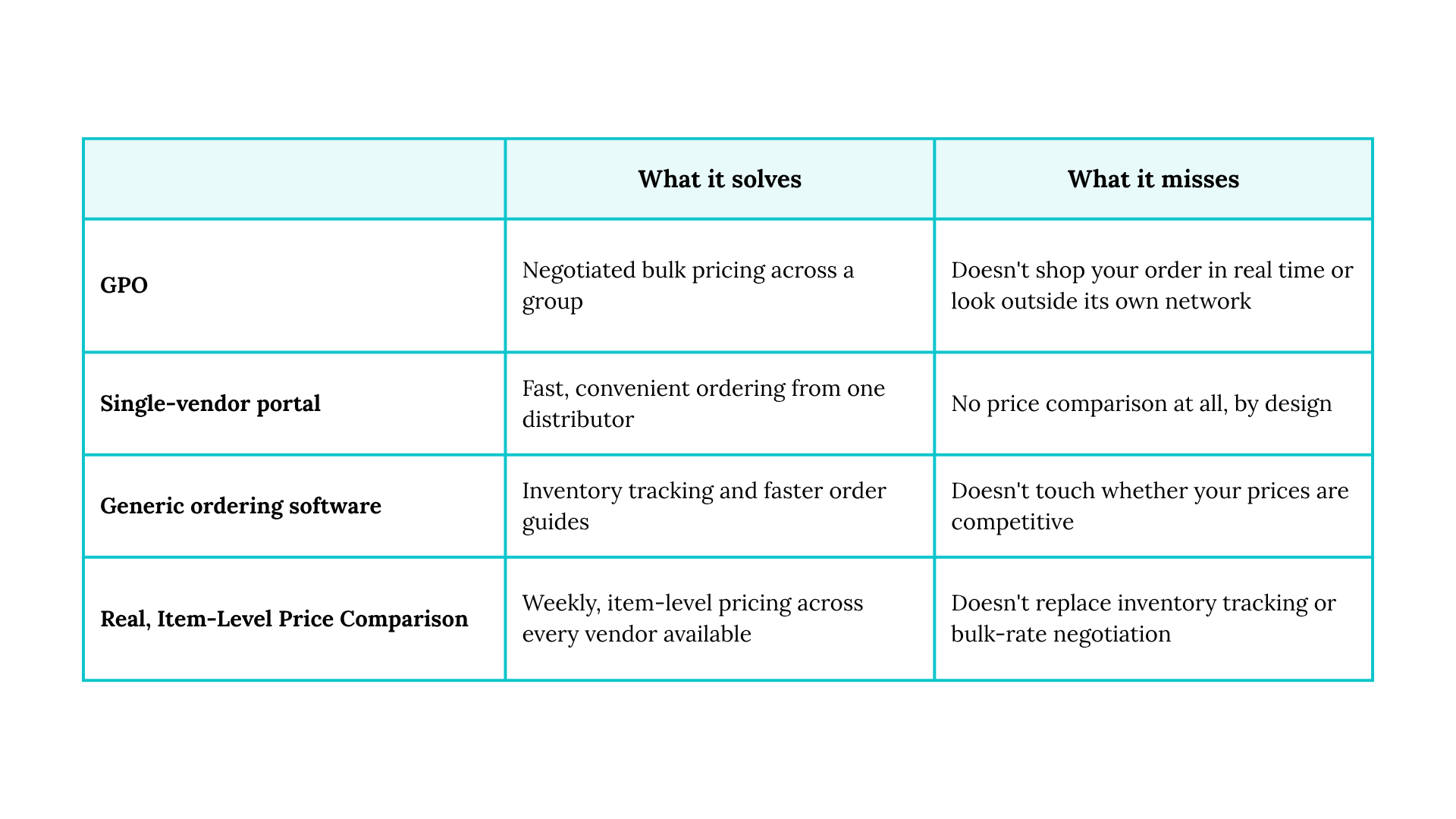
None of these four are inherently wrong to use. Plenty of operators run a GPO membership and an inventory platform at the same time, and that's a reasonable setup. What matters is understanding what each one is actually built to do, so you're not assuming your GPO membership or your distributor portal is covering a job it was never designed for.
The Question Worth Asking About Whatever You're Using Now
Whatever combination of these you're running today, there's one question none of them fully answer: this week, on this order, is there a vendor out there beating the price you're about to pay?
If the honest answer is "I'm not sure," that's not a knock on your setup. It just means you're using tools built for negotiation, convenience, or inventory, none of which were ever built to answer that specific question. That's a different job, and it's the one worth solving next.